Russian
 French
 Spanish


All travelers to Nepal must hold a valid passport for at least six months beyond your expected date of departure to Nepal.
An entry visa for Nepal is required which you can obtain either in advance from your local Nepalese embassy through www.immigration.gov.np, or upon arrival in Nepal at Tribhuvan International Airport (TIA) for which you will need an extra passport size photo with you.
You must get your arrival card ready and fill out your details accurately. Tourist Visa fees for 15 or 30 or 90 days are USD$ 30, USD$ 50 & USD$ 125 respectively. Once you’ve paid the visa cost and submitted the arrival card, you will receive a printed receipt. After you have collected your luggage, you can then continue to get a SIM card.
GETTING A LOCAL SIM CARD
Acquiring a local SIM card is highly recommended for safety and communication. You can purchase one immediately upon arrival at Tribhuvan International Airport (TIA), where official Ncell and Nepal Telecom (NTC) counters are located in the arrivals hall beside the baggage section and are typically open for all international flights.
An entry visa for Nepal is required which you can obtain either in advance from your local Nepalese embassy through www.immigration.gov.np, or upon arrival in Nepal at Tribhuvan International Airport (TIA) for which you will need an extra passport size photo with you.
You must get your arrival card ready and fill out your details accurately. Tourist Visa fees for 15 or 30 or 90 days are USD$ 30, USD$ 50 & USD$ 125 respectively. Once you’ve paid the visa cost and submitted the arrival card, you will receive a printed receipt. After you have collected your luggage, you can then continue to get a SIM card.
MEET & GREET
Look out for our office representative who will be holding a Himalayan Rambler placard. He/she will accompany you to your hotel, and will help you check-in.
Please avoid bystanders or agents who call out to offer to help you with your luggage.
If, by unforeseen circumstances, you don’t meet the designated airport representative at the airport for pick up, please WhatsApp our number +9779851403592. This will enable us to manage logistics accordingly.
ACCOMMODATION IN KATHMANDU
We offer various accommodation choices in Kathmandu tailored to our guests' interests. For first-time visitors who enjoy the vibrant energy and "buzz" of the city, we recommend staying in or near Thamel. For seasoned travelers seeking a more peaceful and quiet atmosphere, we recommend staying near the spiritual hub of Boudha.
For your arrival in Kathmandu, you will be staying at Hotel
Dolmaling in Boudha.
The hotel is ideally located within walking distance of
the sacred Boudhanath Stupa, offering a serene environment away
from the city noise. Your stay includes free Wi-Fi and daily
breakfast (unless stated otherwise). During your time here,
you can enjoy the on-site restaurant and the outdoor swimming
pool. For those interested in wellness, the hotel also offers
exquisite experiences such as Yoga classes and Sound Healing
Therapy upon request (available for an additional fee).
- Phone: +977-01-4917937
- Website: www.hoteldolmaling.com
GETTING AROUND TOWN
Navigating Kathmandu can be an adventure, though the city’s traffic and crowded streets can be challenging.
- Exploring Thamel: Thamel is Kathmandu’s vibrant tourist hub, located approximately 7 km (a 30-minute drive) from Hotel Dolmaling. It is packed with colorful shops, trekking gear stores, and a wide variety of restaurants.
- Peak Traffic Hours: Travel times can increase significantly during peak office hours: 9:00 AM – 11:00 AM and 4:00 PM – 7:00 PM.
- Public Transportation: We strongly suggest avoiding local buses or vans, as they are often crowded well beyond capacity and are difficult to navigate.
- Taxis: Taxis are readily available. Always negotiate the fare beforehand, as drivers rarely use the meter for tourists. Please note that taxi fares typically double after 9:00 PM.
- Ride-Sharing Apps: For fair and transparent pricing, we recommend using apps such as Pathao, Indrive, or Yango. A typical car ride from Boudha to Thamel costs between NPR 350 and NPR 500 during normal hours.
- Personal Assistance: If you plan on exploring independently, consult your trekking guide or a Himalayan Rambler’s representative for the safest and most efficient transport options.

Confused by the choices?
Take our 2-minute Trek Finder quiz to discover the ideal adventure for your fitness and style.
Search PackagesNEPALESE PEOPLE
Nepal is home to approximately 30 million people, forming a rich tapestry of 142 distinct ethnic groups and over 120 spoken languages.
Despite Nepal’s small size, its culture, religion, lifestyle, food, and festivals have been dictated by its geography for centuries. The dramatic rise from the tropical lowlands near the Indian border, northward through the terraced mid-hills , and finally up to the high-altitude valleys of the Himalayas, governs almost every aspect of Nepali life.
While the population is beautifully mixed in cities and urban sprawls, traditional settlements generally follow these three geographic tiers:
-
Himal
– The High Himalayas
The Himalayas are home to the world’s highest peaks, including Everest, Kanchenjunga, Makalu, and Dhaulagiri, and the resilient Sherpa, Tamang, and Rai people whose way of life is shaped by the thin air and the challenges of living high in the mountains. Many people here have a long history of trading across the borders into Tibet.
Further north, behind the high mountains, lie the dry plateaus of Mustang and Dolpo. Because the mountains block the rain, these regions resemble high-altitude deserts. The Loba and Dolpo-pa people still follow ancient salt-trade routes and practice forms of Tibetan Buddhism and the ancient Bon religion, preserving traditions unchanged for centuries.
-
Pahad –
The Middle Hills & Valleys
Between the high peaks and the southern plains lie the Middle Hills, the cultural heart of Nepal. This region is the traditional home of the Magar and Gurung communities—warrior tribes famed for their bravery in the British Gurkha Army—alongside the Khas-Arya (Brahmin and Chhetri).
The Middle Hills also serve as the gateway to iconic treks such as the Annapurna Circuit, Manaslu Circuit, and the Langtang Valley. The lakeside city of Pokhara is a central hub, both a trailhead and trail end for many journeys. In the Kathmandu Valley, visitors encounter the rich culture of the Newar people, renowned for their art, architecture, and traditions.
-
Terai –
The Plains
Between the high peaks and the southern plains lie the Middle Hills, the cultural heart of Nepal. This region is the traditional home of the Magar and Gurung communities—warrior tribes famed for their bravery in the British Gurkha Army—alongside the Khas-Arya (Brahmin and Chhetri).
Golden sunset over Nuptse from Lobuche
The evolution of infrastructure has dramatically morphed the Everest Base Camp Trek experience into distinct worlds—from a shared room costing $10 to a heated suite costing $200. While it is nearly impossible to categorize the Everest experience perfectly, we have tried to distill it into two distinct journeys:
The Ground Reality
A world of shared toilets, cold rooms, communal dining, and bumpy local bus rides.
The Sky Reality
A world of private helicopters, electric blankets, attached bathrooms, and luxury lodges.
RELIGION
In Nepal, religion is not a boundary but a gradient. It is shaped by geography: the closer a community is to the Tibetan plateau or the Indian plains, the more their faith reflects those neighbors. Yet, at its heart, Nepal practices a "Great Synthesis" where Hindu, Buddhist, and Animist traditions often share the same temples, deities, and respect for the land.
The Northern Peaks: Buddhism & Bon In the high altitudes, spirituality is an extension of the Tibetan plateau.
- The Faith: Primarily Tibetan Buddhism. Villages are centered around monasteries (Gumbas), and the landscape is dotted with prayer flags and stone shrines (Chortens).
- The Practitioners: Sherpa, Tamang, and Bhotia communities.
- The Ancient Path: In the remote rain-shadow deserts of Mustang and Dolpo, you will find the Loba and Dolpo-pa. They are the world’s primary keepers of Bon, an ancient animistic faith that predates Buddhism. Their rituals are deeply mystical, focusing on spirits of the mountains and water.


LIFESTYLE
The Nepalese lifestyle embodies the indomitable human spirit in its most authentic form, where life is not merely lived, but masterfully navigated.
Whether it is the Sherpa establishing routes on 8,000-meter peaks or a farmer in the middle hills carving life out of vertical cliffs, the people of Nepal embody a quiet, unbreakable perseverance. This resilience is not born of ease, but of a deep, ancestral harmony with a landscape that demands everything and gives back in beauty.
The Himalayan Dwellers
The high north—home to the Sherpa and other Tibeto-origin people—was once defined by yak herding and salt trading, but has now evolved to host iconic treks and expeditions. Among them, the Sherpas have become synonymous with Himalayan mountaineering, primarily due to their genetic adaptation to "thin air."
- The Multi-Talented Mountain Elite: Today, Sherpas are not just climbers; they are entrepreneurs who own the tea houses and logistics agencies that power the trekking economy.
- The Explorers of the Hills: The Rai and Magar communities from the middle hills have a dual legacy. Renowned globally for their bravery as Gurkha soldiers, they also have a centuries-old history as the primary explorers of the rugged mid-hills. Their legendary stamina and navigation skills made them the early “engines” of Himalayan exploration.
A massive cargo truck navigating a hairpin turn on a cliffside road at the
Chinese border.
The ancient salt trading routes have transformed into modern arteries like Rasuwagadhi, where Chinese electronics and electric vehicles flow into the country, while the southern Terai border acts as the nation’s primary industrial gateway to India.
Everest Base Camp Trek Daily Distance Breakdown
| Day | Location | Distance (km) | Duration (hours) |
| 2 | Lukla – Phakding | 8 km | 3 to 4 hrs |
| 3 | Phakding – Namche Bazaar | 12.3 km | 5 to 6 hrs |
| 4 | Namche Bazaar (Acclimatization) | 7.2 km | 4 to 5 hrs |
| 5 | Namche Bazaar – Tengboche | 10.7 km | 5 to 6 hrs |
| 6 | Tengboche – Dingboche | 10.8 km | 5 to 6 hrs |
| 7 | Dingboche (Acclimatization) | 5.2 km | 4 to 5 hrs |
| 8 | Dingboche – Lobuche | 8.8 km | 5 to 6 hrs |
| 9 | Lobuche – Everest Base Camp – Gorakshep | 11.5 km | 8 to 9 hrs |
| 10 | Gorakshep – Kalapatthar – Pheriche | 17.2 km | 8 to 9 hrs |
| 11 | Pheriche – Namche Bazaar | 19.7 km | 7 to 8 hrs |
| 12 | Namche Bazaar – Lukla | 19.9 km | 8 to 9 hrs |
The Cliff Hunters: In the rugged hills, the Rai, Gurung and Magar practice Honey Hunting. Scaling 200-foot handmade bamboo ladders to harvest wild "Mad Honey" from the cliffs is a display of the same bravery that defines their history as warriors.
The Cliff Hunters: In the rugged hills, the Rai, Gurung and Magar practice Honey Hunting. Scaling 200-foot handmade bamboo ladders to harvest wild "Mad Honey" from the cliffs is a display of the same bravery that defines their history as warriors.
Need a Mixed Plan?
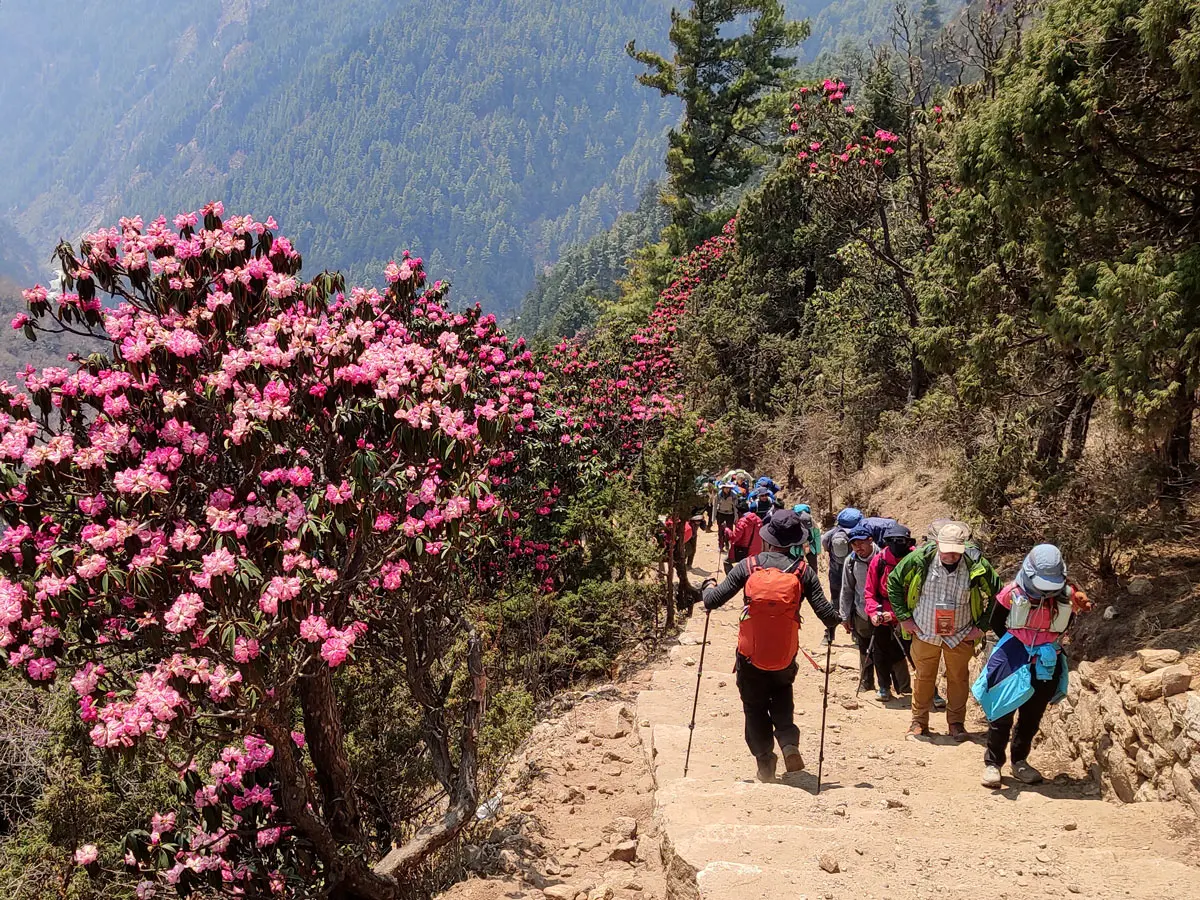
Most hikers choose Standard, with Budget in the higher altitude stops. Let us tailor a perfect balance for you.
View All Packages
 Everest Sherpa expedition